Early Fall Migration at Prewitt Reservoir
This past Sunday I was invited by friends to make the trek out to the northeast corner of the state to bird at Prewitt Reservoir (Hotspot), a large irrigation and recreation reservoir along the South Platte River. The reservoir itself was built in the early 1900s by Great Western Sugar Company to ensure late-season water was sufficient for the burgeoning sugar beet industry in that part of the state.
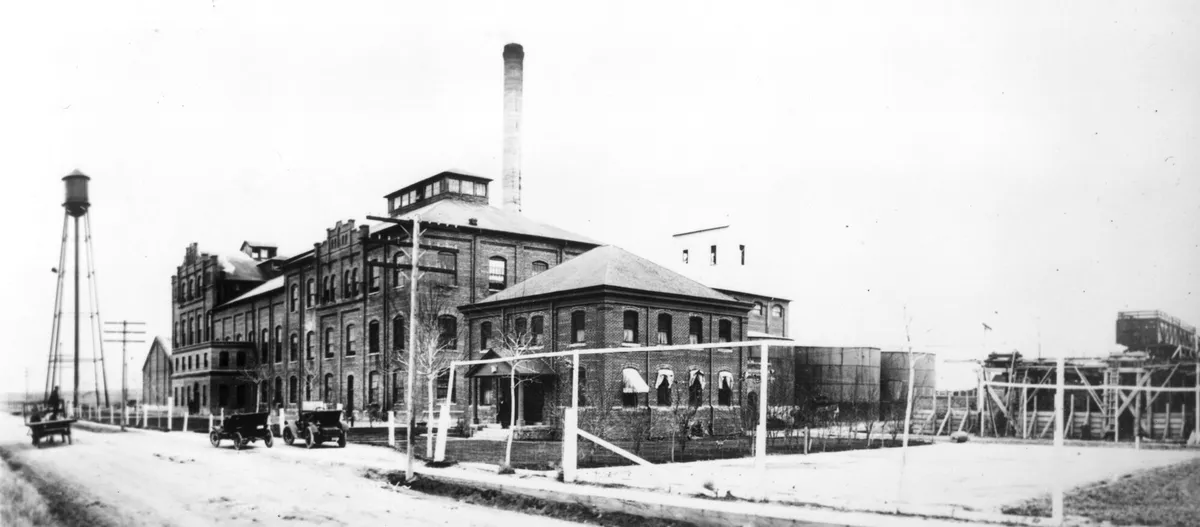 Great Western Sugar Beet factory at Brush, Colorado, ca. 1910-1925. (Denver Public Library Special Collections, X-10502)
Sugar beets were a critical crop to the economic development of Colorado, and at one time Great Western Sugar Company operated some 20 sugar factories in the state. Only one of those is left in Fort Morgan, which operates now as part of Western Sugar Cooperative. Great Western Sugar Company was started in part by Charles Boettcher, which should be a familiar name to those who live in Colorado. The Boettcher family name is in wide circulation around the state, including the Boettcher Mansion, which is the official Governor's residence in Denver, a second Boettcher Mansion atop Lookout Mountain west of Denver which served as his summer home and hunting lodge, and Boettcher Concert Hall, home of the Colorado Symphony. The Boettchers were involved in a variety of enterprises in Colorado in the late 19th century into the 20th century, of which Great Western Sugar Company was just one. Sugar beets declined in importance throughout the century, in part due to regulation, in part due to competition from imported cane sugar. The Coloradoan published an interesting capsule history some years ago with more details, and the Sesame Street video referenced in that article is worth the minute it takes to watch.
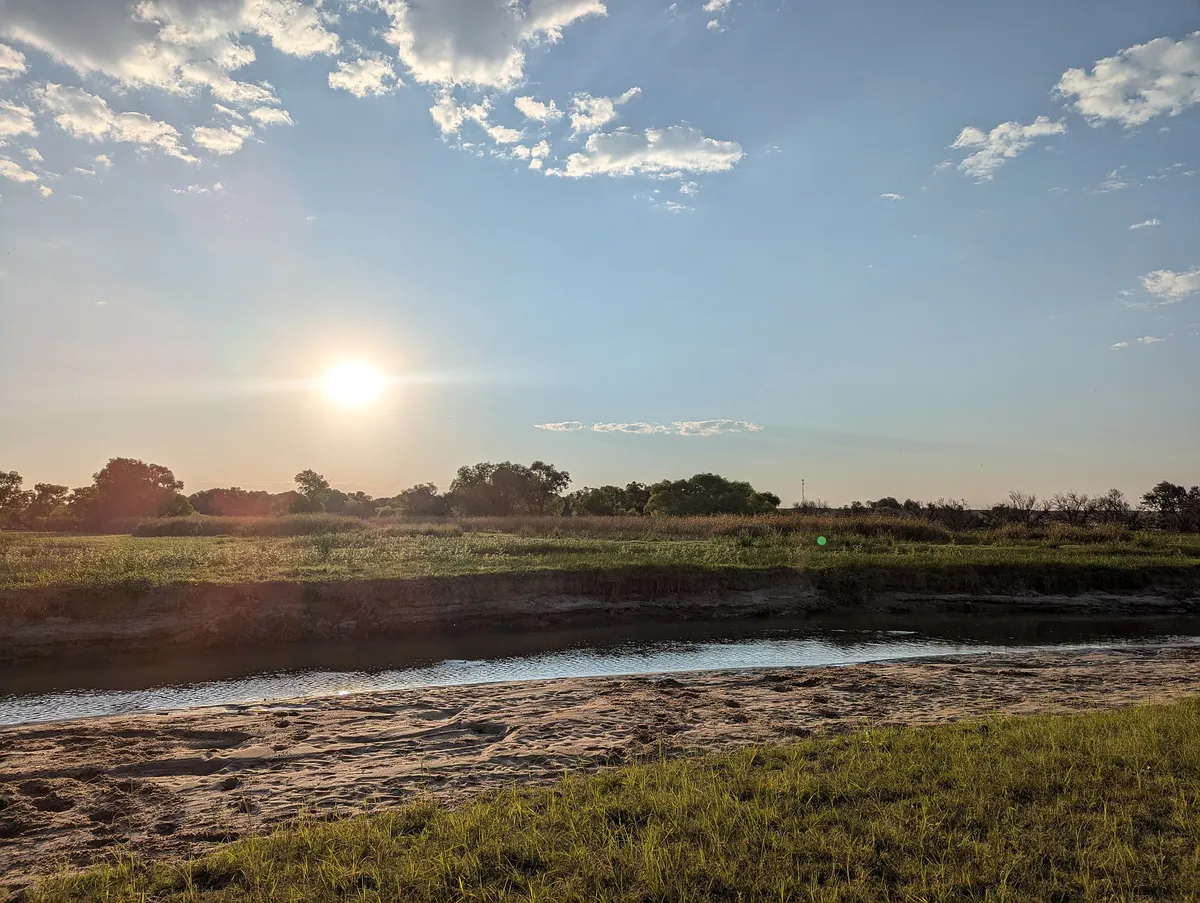
This was my third visit to this hotspot and we started at the inlet canal, which is probably the birdiest area here. The canal runs generally west to east from the South Platte into the reservoir on the south end. Within the State Wildlife Area it runs more northeast. Birding is most accessible here on the north/west side of the canal. Where we parked we immediately got on some birds. Two American Kestrels were harassing a Cooper's Hawk in a cottonwood. A Russian olive that stands in the field in the middle of the loop road here hosted a number of species that we observed, including Wilson's Warbler, two female Orchard Orioles, and two Brown Thrashers.
Walking the inlet itself yielded plenty more Wilson's Warblers, Common Yellowthroats, a lot of American Robins - one seen being pursued by a Loggerhead Shrike. Reading in The Sibley Guide to Bird Life & Behavior (Library) after returning home, I came across this sentence:
Shrikes can kill and cache birds as large as Northern Mockingbirds (Mimus ployglottos), and one Loggerhead Shrike was observed taking a Mourning Dove (Zenaida macroura). 1
This is fairly amazing to me as a Loggerhead Shrike is around 9 inches long and under two ounces in weight, while Mourning Doves are up to almost 12 inches long and weigh in over four ounces. We all know shrikes are fierce, but did you know they are quite that fierce? I didn't until this trip.
Maybe the best bird we observed at the inlet was a Gray Flycatcher doing its characteristic tail pump. Immediately after we linked up with a small group of younger birders who were tailing a mixed flock of Townsend's and Wilson's Warblers through the canopy. While we all observed together and talked about IDs and what we'd seen during the morning, a Black-and-White Warbler made an appearance, as well as a male American Redstart in its beautiful sharp-looking black and orange plumage. Lingering in this spot also yielded a couple Red-headed Woodpeckers, which are always a fun sight for a woodpecker fan like me.
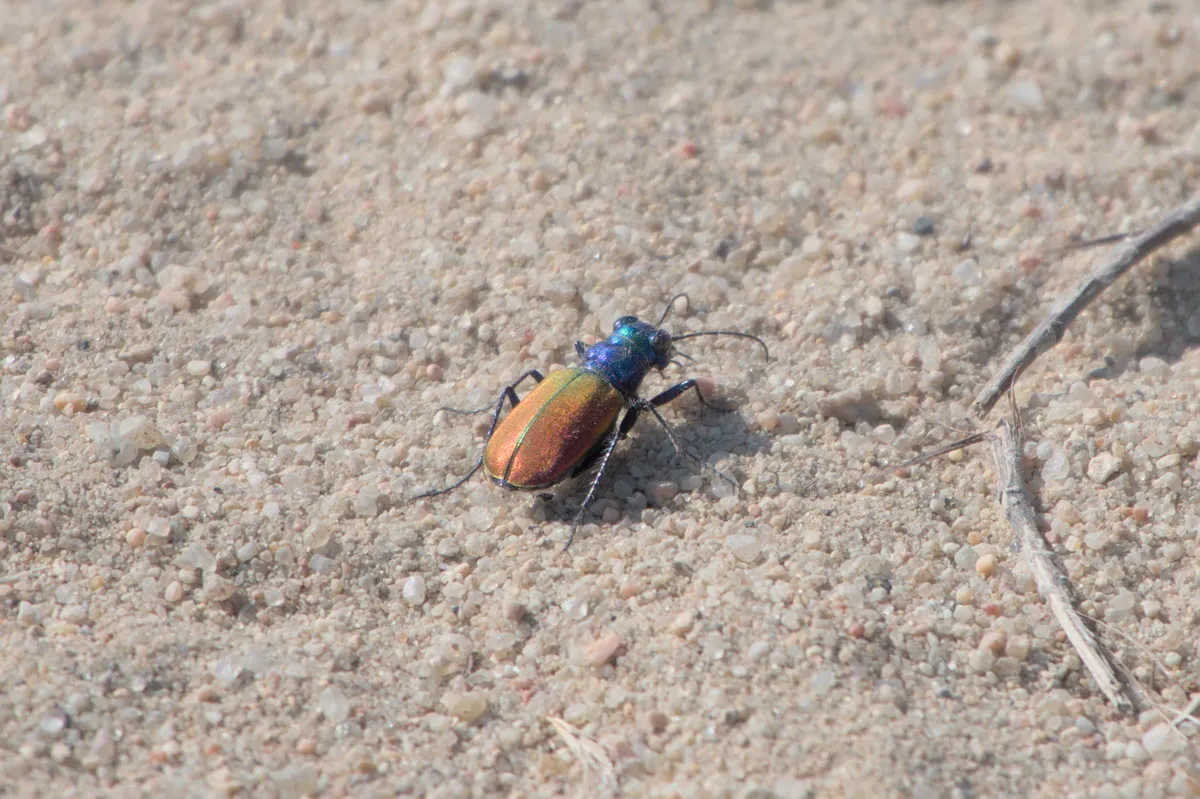
The rest of our time in this gallery forest didn't really yield too many more new species, so we headed out to the road to walk back to the car. The road was not very birdy by this point, but we did have some very eye-catching Festive Tiger Beetles to keep us company.
Our next stop was the mudflat west/north of where the canal enters the reservoir. There were plenty of White-faced Ibis, yellowlegs (both Greater and Lesser), Killdeer, and Stilt Sandpipers. There were also a few Pectoral, Baird's, and Least Sandpipers. Unfortunately we either arrived too late or were in the wrong spot for American Golden Plover and Short-billed Dowitcher reported by the other group of birders - both of which represent desired lifers for my own list. Next time.
For the finale, we made our way up to bird below the dam. It was fairly warm by this time in the late morning, and there was not a lot of bird activity. But we had maybe our best bird of the day - a perched Broad-winged Hawk. We all did our best to get good looks at it before it flew off, and the best ID we could put on it in the field was maybe a Prairie Falcon, or even a Cooper's Hawk. Thankfully one of our group is a great bird photographer and got clear, identifiable photos of it and it seems like it was actually a juvenile Broad-winged Hawk, always a good hawk in Colorado. We also had both Sora and Virginia Rail calling in the same vicinity in one cat-tail marsh we passed, the second time that has happened to me this year.
All in all it was a fine morning out birding, something I haven't done too much of over the summer. Prewitt really is a fun place bird-wise, and the more I visit this area of the state, the more it dawns on me how rich this area is in Colorado state history.
The South Platte out this far from Denver has hosted a few trails I'm currently aware of: the Overland Trail from Atchison, Kansas, the South Platte Trail between Kearny, Nebraska and Denver, and the Pony Express Trail (which just enters the state at Julesburg before departing again through the Nebraska panhandle into Wyoming). The valley and its numerous stage stations and settlements were targets for plains Indian tribes in the Colorado War, a retributive campaign waged by several tribes largely in response to the Sand Creek Massacre of late 1864 in what is now southeastern Colorado. "Fort Wicked", the original site of which is less than a mile north of the dam at Prewitt, is noted as being one of few successful holdouts against these attacks. I would love to spend more time out here exploring these stories.
David Allen Sibley, The Sibley Guide to Bird Life & Behavior (New York: Chanticleer Press, 2001), 399.↩